The Aurora from Terje Sorgjerd on Vimeo.
domingo, março 27, 2011


terça-feira, março 22, 2011
sexta-feira, março 11, 2011
terça-feira, março 08, 2011
Uma prova ou mais uma ilusão?
Folha de S. Paulo, 08/3/2011
Nasa afirma ter encontrado fóssil de vida "ET" em meteorito
Cientistas, no entanto, têm criticado duramente a descoberta
Imagem de bactéria fossilizada encontrada em meteoro
SABINE RIGHETTI
DE SÃO PAULO
A equipe de astrobiologia da Nasa está de novo chamando atenção da comunidade científica. Desta vez, um cientista diz ter encontrado evidências de bactérias extraterrestres fossilizadas em três meteoritos que atingiram a Terra.
A polêmica está em um artigo assinado pelo astrobiólogo da Nasa Richard Hoover, publicado na revista científica americana "Journal of Cosmology".
O estudo afirma que, durante uma análise da estrutura dos meteoritos, foram encontradas evidências de organismos similares às cianobactérias (que podem viver em condições extremas).
A característica desses organismos, no entanto, seria diferente das bactérias terrestres. Para o autor do trabalho, o tamanho e a composição química dos filamentos não condizem com o que existe aqui na Terra.
Hoover descartou a possibilidade de que as estruturas tenham sido contaminadas depois que os meteoritos caíram no planeta.
Para ele, a quantidade mínima de nitrogênio encontrada neles mostra que são fósseis realmente antigos.
CONTROVÉRSIA
O "Journal of Cosmology" recebeu duras críticas da comunidade científica, que alegou que a publicação não tem credibilidade -inclusive porque é independente e tem livre acesso na internet.
Cientistas também afirmaram que a pesquisa de Hoover não reuniu as evidências necessárias para comprovar suas afirmações.
Mas o editor do "Journal of Cosmology", o astrofísico Rudolph Schild, da Universidade de Harvard, rebateu as críticas recebidas.
Em um comunicado, ele chamou o trabalho de "muito importante" e disse ter convocado especialistas para que comentem o estudo.
"Convidamos cem especialistas que enviaram um convite a mais de 5.000 cientistas para revisarem o estudo e apresentarem suas análises críticas", disse.
De acordo com o astrobiólogo Douglas Galante, do Instituto de Astronomia, Geofísica e Ciências Atmosféricas da USP, os resultados achados ainda são preliminares.
"O interessante é que a validação desses dados está sendo feita de maneira aberta à comunidade científica."
"Isso é bem diferente do que aconteceu quando a Nasa anunciou a descoberta da bactéria que substituiu o fósforo [um dos seis elementos essenciais à vida] pelo arsênio na sua composição", diz.
Essa pesquisa, publicada em dezembro de 2010, ainda tem recebido críticas.
Cientistas, no entanto, têm criticado duramente a descoberta
Riccardo Guerrero/Reuters |
SABINE RIGHETTI
DE SÃO PAULO
A equipe de astrobiologia da Nasa está de novo chamando atenção da comunidade científica. Desta vez, um cientista diz ter encontrado evidências de bactérias extraterrestres fossilizadas em três meteoritos que atingiram a Terra.
A polêmica está em um artigo assinado pelo astrobiólogo da Nasa Richard Hoover, publicado na revista científica americana "Journal of Cosmology".
O estudo afirma que, durante uma análise da estrutura dos meteoritos, foram encontradas evidências de organismos similares às cianobactérias (que podem viver em condições extremas).
A característica desses organismos, no entanto, seria diferente das bactérias terrestres. Para o autor do trabalho, o tamanho e a composição química dos filamentos não condizem com o que existe aqui na Terra.
Hoover descartou a possibilidade de que as estruturas tenham sido contaminadas depois que os meteoritos caíram no planeta.
Para ele, a quantidade mínima de nitrogênio encontrada neles mostra que são fósseis realmente antigos.
CONTROVÉRSIA
O "Journal of Cosmology" recebeu duras críticas da comunidade científica, que alegou que a publicação não tem credibilidade -inclusive porque é independente e tem livre acesso na internet.
Cientistas também afirmaram que a pesquisa de Hoover não reuniu as evidências necessárias para comprovar suas afirmações.
Mas o editor do "Journal of Cosmology", o astrofísico Rudolph Schild, da Universidade de Harvard, rebateu as críticas recebidas.
Em um comunicado, ele chamou o trabalho de "muito importante" e disse ter convocado especialistas para que comentem o estudo.
"Convidamos cem especialistas que enviaram um convite a mais de 5.000 cientistas para revisarem o estudo e apresentarem suas análises críticas", disse.
De acordo com o astrobiólogo Douglas Galante, do Instituto de Astronomia, Geofísica e Ciências Atmosféricas da USP, os resultados achados ainda são preliminares.
"O interessante é que a validação desses dados está sendo feita de maneira aberta à comunidade científica."
"Isso é bem diferente do que aconteceu quando a Nasa anunciou a descoberta da bactéria que substituiu o fósforo [um dos seis elementos essenciais à vida] pelo arsênio na sua composição", diz.
Essa pesquisa, publicada em dezembro de 2010, ainda tem recebido críticas.
segunda-feira, março 07, 2011
A pergunta proibida da Era Nuclear

Finalmente terminei de assistir Dr. Strangelove (no Brasil, "Dr. Fantástico"), um clássico da era nuclear. Lançado em 1964, dirigido por ninguém menos que Stanley Kubrick e estrelado por Peter Sellers, o filme é uma grande comédia de humor negro que trata, no entanto, de uma questão ainda hoje muito real: e se alguém -- seja um alto oficial ou um presidente inconsequente -- decidir lançar um ataque nuclear maciço? No filme, a decisão é tomada por um oficial da Força Aérea, enlouquecido com teorias da conspiração repetidas no auge da Guerra Fria por extremistas de direita (já ouviu falar do que estaria por trás da fluoretação da água?). Mas na vida real isso seria possível? Dr. Strangelove começa com uma advertência de que a Força Aérea americana garantia que a situação do filme seria impossível na vida real; mas um jornalista da revista Slate escreveu um livro para mostrar que não é bem assim.
Reproduzo aqui parte da matéria que ele fez para a Slate. É assunto grave, que, mais do que apenas relações internacionais ou política, envolve uma gravíssima questão ética: dada a natureza indiscriminada e em grande escala da destruição causada por armas nucleares, existe justificativa para seu uso?
Se você nunca se perguntou isso, caro leitor, então você não tem plena consciência do mundo em que vive. Então, leia o artigo e chegue a suas próprias conclusões. O texto integral pode ser lido aqui: http://www.slate.com/id/2286735/pagenum/all/
--------
An Unsung Hero of the Nuclear Age
Maj. Harold Hering and the forbidden question that cost him his career.
Posted Monday, Feb. 28, 2011, at 5:40 PM ET It was a risk. Dedicating a book to someone I'd had had a five-minute phone conversation with three decades ago. Someone who, last I'd heard, had become a long-haul trucker and whom I'd given up trying to track down.
But I went ahead and dedicated my new book,How the End Begins: The Road to a Nuclear World War III, to Maj. Harold Hering because Maj. Hering sacrificed his military career to ask a Forbidden Question about launching nuclear missiles. A question that exposed the comforting illusions of the so called fail-safe system designed to prevent "unauthorized" nuclear missile launches.
It was a question that changed his life, and changed mine, and may have changed—even saved—all of ours by calling attention to flaws in our nuclear command and control system at the height of the Cold War. It was a question that makes Maj. Hering an unsung hero of the nuclear age. A question that came from inside the system, a question that has no good answer: How can any missile crewman know that an order to twist his launch key in its slot and send a thermonuclear missile rocketing out of its silo—a nuke capable of killing millions of civilians—is lawful, legitimate, and comes from a sane president?
I tried to track Hering down before my book went to press but failed to connect. And so I chanced it, dedicating the book to someone who, for all I knew, had gone from self-sacrificing hero to—who knows?—subprime mortgage broker? Not that it would have diminished his original sacrifice; heroes don't always fare well after they've left the stage, especially when they go unsung.
But I had an intuition when I first read about Maj. Harold Hering and his Forbidden Question that in addition to courage he had a rare kind of uncompromising integrity. And when I finally tracked him down ... well, let me first explain why I think he's an American hero.
Let's say you were a Minuteman missile crewman during the Richard Nixon presidency at the very height of the Cold War. You and your fellow crewmen are down in your underground launch control center, tending to your sector of the "silo farm"—the vast field under which nuclear missile silos (actually heavily reinforced concrete silo-shaped holes in the ground) shelter the instruments of mass death that lurk beneath the bleak badlands of the northern Great Plains. There you are, running through a drill, going down a routine checklist for launch readiness, when suddenly you get what seems like a reallaunch order. Not a drill. Get ready to twist your launch keys in their slots and send anywhere from one to 50 missiles rocketing toward Russia. World War III is under way.
Or is it? Your launch order codes are "authenticated," everything seems in order, the seconds tick away. But in what may be the last seconds of your life—for all you know Soviet missiles are about to rain down on the plains—a thought crosses your mind. About "authentication." It's supposed to ensure that the launch order comes from the president himself, or (if the president has been killed) from the surviving head of the nuclear chain of command.
But what about that person at the top of the chain of command, the person who gives the order? Has he been "authenticated"? Who authenticates the authenticator? Can the president start a nuclear war on his own authority—his own whim or will—alone? The way Brigadier Gen. Jack D. Ripper did in Dr. Strangelove? What if a president went off his meds, as we'd say today, and decided to pull a Ripper himself? Or what if a Ripper-type madman succeeded in sending a falsely authenticated launch order? You're about to kill 10 million people, after all.
 Such a scenario was not inconceivable at the time when Maj. Hering was going through missile training class at Vandenberg Air Force base. Bruce Blair (then a missile crewman himself, a wing commander in charge of 200 minuteman missiles, and now the head of the nuclear abolitionist Global Zero Initiative) discloses in my book that he had figured out a way to launch all 200 of his "birds" without authorization. Good thing he's a very stable guy.
But you've probably read about Richard Nixon acting erratically, drinking heavily as Watergate closed in on him. You may not have read about the time he told a dinner party at the White House, "I could leave this room, and in 25 minutes, 70 million people would be dead." (Try that line out at one of your dinner parties. I've always found it a good conversation starter.)
Anyway, back down there in your launch capsule you might allow yourself to wonder: "This launch order, is this for real or for Nixon's indigestion?"
If you were asking yourself that question, you wouldn't be the only one. James Schlesinger, secretary of defense at that time, No. 2 in the nuclear chain of command, was reported to be so concerned about Nixon's behavior that he sent word down the chain of command that if anyone received any "unusual orders" from the president they should double-check with him before carrying them out.
So there you are, having just received the order to launch nuclear genocide. Should you suppress any doubts, twist your launch key in the slot simultaneously with your fellow crewman and send death hurtling toward millions of civilians halfway around the world? Without asking questions? That's what you're trained to do, not ask questions. Trainees who asked questions were supposed to be weeded out by the Air Force's "psychiatric consideration of human reliability" requirement. I've read this absurd Strangelovian document, which defined sane and reliable as being willing to kill 10 or 20 million people with the twist of a wrist, no questions asked.
Maj. Hering decided to ask his question anyway, regardless of consequences: How could he know that an order to launch his missiles was "lawful"? That it came from a sane president, one who wasn't "imbalance[d]" or "berserk," as Maj. Hering's lawyer eventually, colorfully put it?
Hering needed a lawyer because as soon as he asked the question he was yanked out of missile training class, and after two years of appeals, eventually had to leave the Air Force, trade in a launch key for the ignition keys to an 18-wheeler.
But he forced the Air Force to face the question. We couldn't ignore the problem any longer. Although, as it turned out, we couldn't solve it, either.
(Continua aqui.)
segunda-feira, fevereiro 28, 2011
Vegetarianos e onívoros
Não sou vegetariano. E, para ser franco, também não estou convencido de que sê-lo -- pelo menos no sentido mais completo da palavra -- seja uma opção saudável no mundo de hoje. Carne é um alimento extremamente eficiente sob vários aspectos -- há quem veja nela um dos motivos do sucesso de nossa evolução cerebral, nos duros tempos de nossos antepassados simiescos. Abrir mão dela inteiramente não só dá trabalho, mas exige uma série de cuidados que duvido que a maioria de nós queira ou tenha condições de ter -- pergunte a um pediatra se ele recomenda uma dieta assim para crianças pequenas ou grávidas. No entanto, não seria honesto negar que: a) nunca se comeu tanta carne no mundo; b) isso tem um preço ambiental elevado; c) comer carne tem, sim, implicações éticas; d) comemos mais carne do que realmente precisamos. Por isso, comprei o livro de Saffran Foer, citado abaixo, para conhecer melhor o que ele tem a dizer sobre a questão. E divido com vocês esta reportagem interessante da Folha de S. Paulo, publicada hoje.
--------
Comer ou não comer animais?
jovens elegem vegetarianismo como bandeira política, mas precisam ficar de olho na qualidade do que colocam no prato
Carlos Cecconello/Folhapress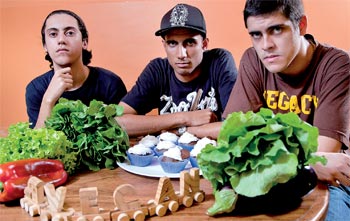 |
LAURA CAPRIGLIONE
DE SÃO PAULO
FERNANDA MENA
EDITORA DO FOLHATEEN
"Meus pais comem muita carne. Minha mãe comprava galinha e matava em casa. Aquilo mexia comigo. Um dia, fui visitar familiares no Nordeste e eles mataram um porco a marretadas! Como tinham coragem de marretar a cabeça de um bicho que era quase de estimação? Ali eu parei." Foi assim que Rodolfo Duarte, 23, gerente de restaurante em São Paulo, riscou as carnes do seu cardápio.
Mesmo sem presenciar um abate, a estudante Laura Viana, 17, chegou à mesma conclusão. "Comecei a achar que, com tantas opções de alimentos, não era necessário criar animais com o único objetivo de comê-los."
Enfrentando os preconceitos que ainda existem contra vegetarianos (seriam hippies tardios, fracotes) e a pressão dos pais (meu filho vai ficar anêmico?), um grupo crescente de jovens tem optado por não comer animais, movidos mais por questões éticas e ambientais do que de saúde (veja quadro à pág.8).
Pesquisa da Escola Superior de Propaganda e Marketing no final de 2010 contabilizou 4% de vegetarianos entre jovens de São Paulo e Rio, das classes A, B e C. Nos EUA, um em cada cinco universitários já aboliu a carne.
Segundo Johathan Safran Foer, autor de "Comer Animais", "virou um fenômeno político. Quando eles se tornarem jornalistas e políticos, o ponto de vista sobre a questão da carne vai mudar completamente", diz.
É nas redes sociais, em eventos como a Verdurada (festival de música com comidinhas sem carne), ou na base da curiosidade que os novos vegetarianos se viram.
A estudante Ana Carvalho, 15, parou de comer carne há três anos e começou a se encher de pão e doces. No fim de 2009, estava anêmica.
Foi um drama. A mãe queria porque queria que ela parasse com aquela história. E Ana concordou em voltar aos bifes. "Só por seis meses." Assim que o sangue voltou ao normal, ela -de novo- aboliu a carne.
"Agora, sigo a dieta indicada por uma médica, com soja, beterraba, cenoura e verduras. Estou ótima", diz.
Segundo o nutrólogo e hebiatra Mauro Fisberg, docente da Universidade Federal de São Paulo, "aprender com os amigos não basta; é importante procurar a ajuda de um médico ou nutricionista para uma dieta equilibrada".
"Quando parei de comer carne, parecia que eu é que era a aberração", diz Thiago Vasconcelos, 18. Nem a mãe dispunha-se a cozinhar para ele. "Eu já sabia cozinhar de forma péssima. Aí, tive de melhorar para ruim."
Muitos vegetarianos são obrigados a aprender a cozinhar, já que ainda há poucas opções nos restaurantes.
Mas conforme tornam-se mais importantes na demografia, grandes indústrias passam a cobiçar o novo mercado. A Perdigão, por exemplo, já oferece produtos como salsicha e hambúrguer de soja. Outras empresas vêm com quibes e linguiças vegetais, bife de glúten e até os inacreditáveis glutadela (mortadela de glúten) e tofupiry (requeijão de tofu).
Já que essa geração de vegetarianos tem mais problemas com os maus-tratos da indústria do abate e seu ônus para o planeta do que com o gosto da carne em si, dá-lhe imitação. "Adoro os industrializados", diz Iran Pereira, 21, da banda Still Strong. É um vegetarianismo muito além das abobrinhas.
"Não há opção fácil do tipo "vou parar de comer hambúrgueres'"
IZABELA MOI
EDITORA-ASSISTENTE DA ILUSTRÍSSIMA
"Comer Animais", lançado no início do mês no Brasil, é a primeira obra de não ficção do premiado autor norte-americano Jonathan Safran Foer ("Tudo se Ilumina"). O livro já saiu em 25 países. "É um livro que mostra como o sistema de produção de alimentos está falido", disse Foer, 33, à Folha. 
Folha - Por que você resolveu escrever "Comer Animais"?
Jonathan Safran Foer - A principal razão foi meu filho. Quando descobri que minha mulher estava grávida e que teríamos a responsabilidade de alimentar outra pessoa, eu quis procurar informações para decidir melhor.
Como é que isso se transformou num livro?
Não tinha como não escrever. Eu tinha de compartilhar todas essas descobertas.
Como as pessoas reagem em suas palestras?
Todo o mundo concorda que o sistema de produção de alimentos está falido e que precisamos de um novo. Afinal, quem quer apoiar um sistema que é a causa número um do aquecimento global? Quem quer um sistema que mantém fêmeas de animais grávidas em espaços tão exíguos que elas não conseguem se mexer durante toda a sua vida?
Como mudar esse sistema sem virar vegetariano?
Não há uma opção fácil do tipo "vou parar de comer hambúrgueres". Temos de reduzir o consumo de carne. Em um planeta que não vai ficar maior, o sistema que existe não é sustentável nem saudável. Na sua próxima refeição, não coma carne.
E se seus filhos quiserem provar carne de vaca ou galinha?
Não sei. Nosso objetivo não é criar vegetarianos, mas formar seres humanos capazes de agir de acordo com seus princípios.
IZABELA MOI
EDITORA-ASSISTENTE DA ILUSTRÍSSIMA
"Comer Animais", lançado no início do mês no Brasil, é a primeira obra de não ficção do premiado autor norte-americano Jonathan Safran Foer ("Tudo se Ilumina"). O livro já saiu em 25 países. "É um livro que mostra como o sistema de produção de alimentos está falido", disse Foer, 33, à Folha.
Folha - Por que você resolveu escrever "Comer Animais"?
Jonathan Safran Foer - A principal razão foi meu filho. Quando descobri que minha mulher estava grávida e que teríamos a responsabilidade de alimentar outra pessoa, eu quis procurar informações para decidir melhor.
Como é que isso se transformou num livro?
Não tinha como não escrever. Eu tinha de compartilhar todas essas descobertas.
Como as pessoas reagem em suas palestras?
Todo o mundo concorda que o sistema de produção de alimentos está falido e que precisamos de um novo. Afinal, quem quer apoiar um sistema que é a causa número um do aquecimento global? Quem quer um sistema que mantém fêmeas de animais grávidas em espaços tão exíguos que elas não conseguem se mexer durante toda a sua vida?
Como mudar esse sistema sem virar vegetariano?
Não há uma opção fácil do tipo "vou parar de comer hambúrgueres". Temos de reduzir o consumo de carne. Em um planeta que não vai ficar maior, o sistema que existe não é sustentável nem saudável. Na sua próxima refeição, não coma carne.
E se seus filhos quiserem provar carne de vaca ou galinha?
Não sei. Nosso objetivo não é criar vegetarianos, mas formar seres humanos capazes de agir de acordo com seus princípios.
CARNE TAMBÉM É ISTO
-O que indústria de abate de animais produz além da carne que chega aos supermercados
-80% das áreas desmatadas do país são ocupadas pelaatividade pecuária
-A criação de animais emite mais gases de efeito estufa do que todo o setor de transportes
-A cada 18 segundos, um hectare de floresta amazônica é convertida em pasto
-O rebanho brasileiro que mais cresce está na região da Amazônia
-Galinhas poedeiras (que botam ovos) vivem numa área menor que uma folha de papel A4 cada. Os pintinhos machos que nascem nessa indústria são "destruídos" em maceradoresporque não têm valor comercial
-6 semanas é o tempo médio de vida de um frango de granja até seu abate. Na natureza, ele viveria cerca de 15 anos. Esse crescimento em tempo recorde é estimulado artificialmente
-Frangos de abate tem seus bicos cortados para não machucarem uns aos outros ou a si próprios, o que é comum no ambiente confinado das granjas
-70% dos estoques pesqueiros comerciais estão ameaçados de extinção
20 das 35 espécies de cavalo-marinho estão ameaçadas de extinção porque são mortas "sem querer" por redes de pesca de arrastão
-Para cada quilo de camarão pescado em redes de arrastão, cerca de 20 quilos de outros animais marinhos são mortos "sem querer" e atirados de volta ao mar
-15 mil litros de água são exigidos na produção de apenas um quilo de carne
-Leitões são castrados sem anestesia e vivem em cercados superpovoados para se locomoverem menos e, assim, engordarem mais e mais rápido
-O que indústria de abate de animais produz além da carne que chega aos supermercados
-80% das áreas desmatadas do país são ocupadas pelaatividade pecuária
-A criação de animais emite mais gases de efeito estufa do que todo o setor de transportes
-A cada 18 segundos, um hectare de floresta amazônica é convertida em pasto
-O rebanho brasileiro que mais cresce está na região da Amazônia
-Galinhas poedeiras (que botam ovos) vivem numa área menor que uma folha de papel A4 cada. Os pintinhos machos que nascem nessa indústria são "destruídos" em maceradoresporque não têm valor comercial
-6 semanas é o tempo médio de vida de um frango de granja até seu abate. Na natureza, ele viveria cerca de 15 anos. Esse crescimento em tempo recorde é estimulado artificialmente
-Frangos de abate tem seus bicos cortados para não machucarem uns aos outros ou a si próprios, o que é comum no ambiente confinado das granjas
-70% dos estoques pesqueiros comerciais estão ameaçados de extinção
20 das 35 espécies de cavalo-marinho estão ameaçadas de extinção porque são mortas "sem querer" por redes de pesca de arrastão
-Para cada quilo de camarão pescado em redes de arrastão, cerca de 20 quilos de outros animais marinhos são mortos "sem querer" e atirados de volta ao mar
-15 mil litros de água são exigidos na produção de apenas um quilo de carne
-Leitões são castrados sem anestesia e vivem em cercados superpovoados para se locomoverem menos e, assim, engordarem mais e mais rápido
CAMINHO DO MEIO
-O que carnívoros convictos podem fazer?
-Dê preferência a ovos orgânicos ou caipiras, produzidos por galinhas criadas livres
-Escolha carnes orgânicas e certificadas, com comprovação de origem (para ter certeza de que não ajudaram a desmatar a Amazônia)
-Adote a campanha Segunda Sem Carne. Com isso, você reduz o seu consumo de carne e faz refeições diferentes às segundas-feiras (www.svb.org/segundasemcarne). O ex-beatle Paul McCartney, a apresentadora Oprah Winfrey e os artistas Gilberto Gil, Marisa Monte e Moby já adotaram
DE OLHO NA SAÚDE
Como ser um vegetariano saudável
-Consulte um nutrólogo para aprender a fazer refeições equilibradas e nutritivas. Discuta com ele a necessidade do uso de suplementos vitamínicos
-Segundo alguns nutrólogos, manter ovos e laticínios na dieta é interessante porque são fontes importantes de proteína
-Não dá para ser vegetariano e viver de batata frita e bolacha recheada. Há veganos que consomem mais gordura trans do que os carnívoros. Aprenda a cozinhar
-Quem não come carne tem mais chance de ter anemia, causada por carência de ferro. O ferro de origem vegetal (feijões, cereais integrais, castanhas e folhas verde-escuras) é melhor absorvido pelo corpo se acompanhado de vitamina C (frutas e verduras cruas)
Fontes: Governo Federal, Unesco, Organização das Nações Unidas para a Agricultura e a Alimentação (FAO), WWF, Greenpeace, PETA, Instituto Nina Rosa, "Comer Animais" (de Jonathan Safran Foer) e "Virei Vegetariano. E Agora?" (de Eric Slywitch)
quarta-feira, fevereiro 23, 2011
Resistência e trauma
Seres humanos são frágeis, sim. No esquema geral das coisas, mais ainda. Entretanto, em nossa pequenez ante o resto do universo, podemos também ser muito mais resistentes do que nós mesmos acreditamos. É o que mostra o trecho diário do Delancey Place de hoje:
-------
"Behavioral scientists have accumulated decades of data on both adults and children exposed to trauma. George A. Bonanno of Teachers College at Columbia University has devoted his career as a psychologist to documenting the varieties of resilient experience, focusing on our reactions to the death of a loved one and to what happens in the face of war, terror and disease. In every instance, he has found, most people adapt surprisingly well to whatever the world presents; life returns to a measure of normalcy in a matter of months. ...
"Bonanno started researching how we respond emotionally to bereavement and other traumatic events in the early 1990s while at the University of California, San Francisco. In those days, the prevailing wisdom held that the loss of a close friend or relative left indelible emotional scars - and Freudian grief work or a similar tonic was needed to return the mourner to a normal routine. Bonanno and his colleagues approached the task with open minds. Yet, again and again during the experiments, they found no trace of psychic wounds, raising the prospect that psychological resilience prevails, that it was not just a rare occurrence in in- dividuals blessed with propitious genes or gifted parents. This insight also raised the unsettling prospect that latter-day versions of grief work might end up producing more harm than good.
"In one example of his work, Bonanno and his colleague Dacher Keltner analyzed facial expressions of people who had lost loved ones recently. The videos bore no hint of any permanent sorrow that needed extirpation. As expected, the videos revealed sadness but also anger and happiness. Time and again, a grief-stricken person's expression would change from dejection to laughter and back.
"Were the guffaws genuine, the researchers wondered? They slowed down the video and looked for contraction of the orbicularis oculi muscles around the eyes - movements known as Duchenne expressions that confirm that laughs are what they seem, not just an artifact of a polite but insincere titter. The mourners, it turns out, exhibited the real thing. The same oscillation between sadness and mirth repeated itself in study after study.
"What does it mean? Bonanno surmises that melancholy helps us with healing after a loss, but unrelenting grief, like clinical depression, is just too much to bear, overwhelming the mourner. So the wiring inside our heads prevents most of us from getting stuck in an inconsolable psychological state. If our emotions get either too hot or cold, a kind of internal sensor - call it a 'resilience-stat' - returns us to equilibrium.
"Bonanno expanded his studies beyond bereavement. At Catholic University and later Columbia, he interviewed survivors of sexual abuse, New Yorkers who had gone through the 9/11 attacks and Hong Kong residents who had lived through the SARS epidemic. Wherever he went, the story was the same: 'Most of the people looked like they were coping just fine.'
"A familiar pattern emerged. In the immediate aftermath of death, disease or disaster, a third to two thirds of those surveyed experienced few, if any, symptoms that would merit classification as trauma: sleeping difficulties, hypervigilance or flashbacks, among other symptoms. Within six months the number that remained with these symptoms often fell to less than 10 percent."
Author: Gary Stix
Title: "The Neuroscience of True Grit"
Publisher: Scientific American Magazine
Date: March 2011
Pages: 31-32
"Bonanno started researching how we respond emotionally to bereavement and other traumatic events in the early 1990s while at the University of California, San Francisco. In those days, the prevailing wisdom held that the loss of a close friend or relative left indelible emotional scars - and Freudian grief work or a similar tonic was needed to return the mourner to a normal routine. Bonanno and his colleagues approached the task with open minds. Yet, again and again during the experiments, they found no trace of psychic wounds, raising the prospect that psychological resilience prevails, that it was not just a rare occurrence in in- dividuals blessed with propitious genes or gifted parents. This insight also raised the unsettling prospect that latter-day versions of grief work might end up producing more harm than good.
"In one example of his work, Bonanno and his colleague Dacher Keltner analyzed facial expressions of people who had lost loved ones recently. The videos bore no hint of any permanent sorrow that needed extirpation. As expected, the videos revealed sadness but also anger and happiness. Time and again, a grief-stricken person's expression would change from dejection to laughter and back.
"Were the guffaws genuine, the researchers wondered? They slowed down the video and looked for contraction of the orbicularis oculi muscles around the eyes - movements known as Duchenne expressions that confirm that laughs are what they seem, not just an artifact of a polite but insincere titter. The mourners, it turns out, exhibited the real thing. The same oscillation between sadness and mirth repeated itself in study after study.
"What does it mean? Bonanno surmises that melancholy helps us with healing after a loss, but unrelenting grief, like clinical depression, is just too much to bear, overwhelming the mourner. So the wiring inside our heads prevents most of us from getting stuck in an inconsolable psychological state. If our emotions get either too hot or cold, a kind of internal sensor - call it a 'resilience-stat' - returns us to equilibrium.
"Bonanno expanded his studies beyond bereavement. At Catholic University and later Columbia, he interviewed survivors of sexual abuse, New Yorkers who had gone through the 9/11 attacks and Hong Kong residents who had lived through the SARS epidemic. Wherever he went, the story was the same: 'Most of the people looked like they were coping just fine.'
"A familiar pattern emerged. In the immediate aftermath of death, disease or disaster, a third to two thirds of those surveyed experienced few, if any, symptoms that would merit classification as trauma: sleeping difficulties, hypervigilance or flashbacks, among other symptoms. Within six months the number that remained with these symptoms often fell to less than 10 percent."
Author: Gary Stix
Title: "The Neuroscience of True Grit"
Publisher: Scientific American Magazine
Date: March 2011
Pages: 31-32
terça-feira, fevereiro 22, 2011

sexta-feira, fevereiro 18, 2011
DNA de negros e pardos do Brasil é muito europeu
Estudo diz que cerca de 70% da herança genética nacional vem da Europa
Variação de região para região do país é baixa; cor da pele tem elo com poucos genes e, por isso, é parâmetro enganoso
REINALDO JOSÉ LOPES
EDITOR DE CIÊNCIA
Variação de região para região do país é baixa; cor da pele tem elo com poucos genes e, por isso, é parâmetro enganoso
REINALDO JOSÉ LOPES
EDITOR DE CIÊNCIA
http://www1.folha.uol.com.br/fsp/ciencia/fe1802201101.htm
No Brasil, faz cada vez menos sentido considerar que brancos têm origem europeia e negros são "africanos". Segundo um novo estudo, mesmo quem se diz "preto" ou "pardo" nos censos nacionais traz forte contribuição da Europa em seu DNA.
O trabalho, coordenado por Sérgio Danilo Pena, da UFMG (Universidade Federal de Minas Gerais), indica ainda que, apesar das diferenças regionais, a ancestralidade dos brasileiros acaba sendo relativamente uniforme.
"A grande mensagem do trabalho é que [geneticamente] o Brasil é bem mais homogêneo do que se esperava", disse Pena àFolha.
De Belém (PA) a Porto Alegre, a ascendência europeia nunca é inferior, em média, a 60%, nem ultrapassa os 80%. Há doses mais ou menos generosas de sangue africano, enquanto a menor contribuição é a indígena, só ultrapassando os 10% na região Norte do Brasil.
QUASE MIL
Além de moradores das capitais paraense e gaúcha, foram estudadas também populações de Ilhéus (BA) e Fortaleza (compondo a amostra nordestina), Rio de Janeiro (correspondendo ao Sudeste) e Joinville (segunda amostra da região Sul).
Ao todo, foram 934 pessoas. A comparação completa entre brancos, pardos e pretos (categorias de autoidentificação consagradas nos censos do IBGE) só não foi possível no Ceará, onde não havia pretos na amostra, e em Santa Catarina, onde só havia pretos, frequentadores de um centro comunitário ligado ao movimento negro.
Para analisar o genoma, os geneticistas se valeram de um conjunto de 40 variantes de DNA, os chamados indels (sigla de "inserção e deleção"). São exatamente o que o nome sugere: pequenos trechos de "letras" químicas do genoma que às vezes sobram ou faltam no DNA.
Cada região do planeta tem seu próprio conjunto de indels na população -alguns são típicos da África, outros da Europa. Dependendo da combinação deles no genoma de um indivíduo, é possível estimar a proporção de seus ancestrais que vieram de cada continente.
Do ponto de vista histórico, o trabalho deixa claro que a chamada política do branqueamento -defendida por estadistas e intelectuais nos séculos 19 e 20, com forte conteúdo racista- acabou dando certo, diz Pena.
Segundo os pesquisadores, a combinação entre imigração europeia desde o século 16 e casamento de homens brancos com mulheres índias e negras gerou uma população na qual a aparência física tem pouco a ver com os ancestrais da pessoa.
Isso porque os genes da cor da pele e dos cabelos, por exemplo, são muito poucos, parte desprezível da herança genética, embora seu efeito seja muito visível. O trabalho está na revista "PLoS One".
No Brasil, faz cada vez menos sentido considerar que brancos têm origem europeia e negros são "africanos". Segundo um novo estudo, mesmo quem se diz "preto" ou "pardo" nos censos nacionais traz forte contribuição da Europa em seu DNA.
O trabalho, coordenado por Sérgio Danilo Pena, da UFMG (Universidade Federal de Minas Gerais), indica ainda que, apesar das diferenças regionais, a ancestralidade dos brasileiros acaba sendo relativamente uniforme.
"A grande mensagem do trabalho é que [geneticamente] o Brasil é bem mais homogêneo do que se esperava", disse Pena àFolha.
De Belém (PA) a Porto Alegre, a ascendência europeia nunca é inferior, em média, a 60%, nem ultrapassa os 80%. Há doses mais ou menos generosas de sangue africano, enquanto a menor contribuição é a indígena, só ultrapassando os 10% na região Norte do Brasil.
QUASE MIL
Além de moradores das capitais paraense e gaúcha, foram estudadas também populações de Ilhéus (BA) e Fortaleza (compondo a amostra nordestina), Rio de Janeiro (correspondendo ao Sudeste) e Joinville (segunda amostra da região Sul).
Ao todo, foram 934 pessoas. A comparação completa entre brancos, pardos e pretos (categorias de autoidentificação consagradas nos censos do IBGE) só não foi possível no Ceará, onde não havia pretos na amostra, e em Santa Catarina, onde só havia pretos, frequentadores de um centro comunitário ligado ao movimento negro.
Para analisar o genoma, os geneticistas se valeram de um conjunto de 40 variantes de DNA, os chamados indels (sigla de "inserção e deleção"). São exatamente o que o nome sugere: pequenos trechos de "letras" químicas do genoma que às vezes sobram ou faltam no DNA.
Cada região do planeta tem seu próprio conjunto de indels na população -alguns são típicos da África, outros da Europa. Dependendo da combinação deles no genoma de um indivíduo, é possível estimar a proporção de seus ancestrais que vieram de cada continente.
Do ponto de vista histórico, o trabalho deixa claro que a chamada política do branqueamento -defendida por estadistas e intelectuais nos séculos 19 e 20, com forte conteúdo racista- acabou dando certo, diz Pena.
Segundo os pesquisadores, a combinação entre imigração europeia desde o século 16 e casamento de homens brancos com mulheres índias e negras gerou uma população na qual a aparência física tem pouco a ver com os ancestrais da pessoa.
Isso porque os genes da cor da pele e dos cabelos, por exemplo, são muito poucos, parte desprezível da herança genética, embora seu efeito seja muito visível. O trabalho está na revista "PLoS One".
sexta-feira, fevereiro 11, 2011
A paz vence a espada

The Tweet Is Mightier than the Sword
- 02.11.2011 - 11:48 AMYesterday he was staying, today he is leaving. Who knows what goes on in the mind of a pharaoh? Clearly, Hosni Mubarak was trying to hang on, and just as clearly, the Egyptian military told him no can do. No doubt they realize that their ability to hang onto their privileged position was being imperiled by Mubarak’s desire to cling to his even more privileged position, so they gave him a gentle shove out the door.
There are many points one can make at such an important moment. Obviously, one can cheer on the people of Egypt and wish them the best in creating a democracy — a goal that is only slightly closer to realization with Mubarak out of office. All too many obstacles remain, including the desire of Omar Suleiman and his military backers to maintain the corrupt structures that have dominated Egypt for decades. But for the time being, let me offer a thought as someone who is writing a history of guerrilla warfare and terrorism.
Egypt shows that there is a better way than setting off bombs if you want to change regimes. “People power” protests of the kind we have seen in recent weeks in Cairo and Alexandria have toppled far more rulers in recent decades than all the world’s terrorists and guerrillas combined. East Germany, the Soviet Union, Romania, Serbia, Ukraine, Kyrgyzstan, the Philippines, Lebanon, Georgia, Tunisia, and on and on — the list of countries where popular demonstrations have toppled unpopular regimes is a long one. Now add Egypt to that list.
The success of protesters in Tunisia and Egypt is especially striking because both regimes — along with all the other governments in the Middle East — have been in the cross-hairs of al-Qaeda and their Islamist fellow travelers. Osama bin Laden and his ilk have been using suicide bombers and assassins for many years to try to topple dictatorships across the region. Time after time, they have failed — in Algeria, Egypt, Syria, Iraq, and elsewhere. All those regimes have proved able to repress violent extremists (admittedly, in the case of Iraq, with considerable American help). In Egypt, Mubarak survived the massacres of tourists in the 1990s carried out by Islamist groups. He did not survive peaceful rallies in the heart of his own capital.
There is a lesson here for those not too fanatical or deluded to learn it. Put down the bomb, the sniper rifle, whatever weapon you have, and grab a placard, go on Twitter, organize a rally. True, many peaceful protests have been repressed too, as we have seen most recently in Iran; but they offer a much surer road to regime change than does blowing up innocent people.
quarta-feira, fevereiro 09, 2011
O outro lado do Dia D

Samuel W. Mitcham. Defenders of Fortress Europe: The Untold Story of the German Officers during the Allied Invasion. Washington D.C. Potomac, 2008. 258 pp. $27.50 (cloth), ISBN 978-1-59797-274-1.
Reviewed by Bradley Nichols (University of Tennessee-Knoxville)
Published on H-German (February, 2011)Commissioned by Benita Blessing
Outstanding Officers, SS Fanatics, and Nazi Generals
This study by the prolific Samuel W. Mitcham Jr. examines the western front of the Second World War in 1944-45 from the perspective of German military officers. In a combination of operational military history and extended prosopography, Mitcham presents a compelling narrative of the dramatic clash between Allied and Axis forces in France, from the Normandy landings to the surrender of the last pockets of German resistance in fortress towns on the French coast. However, the work also suffers from methodological problems and a misleading portrayal of the Wehrmacht that will grate on scholars of the Third Reich as well as proponents of war and society studies--though probably not a mass readership of military history buffs. The book's subtitle itself is deceptive. After all, the campaign in France is one of the most heavily covered topics within the historiography on World War Two. Nevertheless, among studies of the western front, there is certainly no book like _Defenders of Fortress Europe_. Mitcham's use of some two hundred previously undisclosed personnel files--a bequest of the late Theodor-Friedrich von Stauffenberg--conveys the social and political complexity of the German officer class in a unique and innovative manner. The work shows how figures like the Old World, aristocratic Gerd von Rundstedt meshed with working-class upstarts like Josef "Sepp" Dietrich; how salty, old Prussian anti-Nazis like Erwin von Witzleben worked alongside fervent National Socialist generals like Walter Model, as well as ideological warriors of the SS (_Schutzstaffel_) like Heinz Lammerding and Kurt "Panzer" Meyer.
Between opposite ends of the spectrum lay officers from a variety of social backgrounds, most of them with mixed views towards the political messages of Nazism. Mitcham illustrates these intricate shadings by touching on the religious persuasions of the men involved as well, something commonly overlooked in studies of the German military and SS. Rundstedt, for example, was a devout Catholic who did not let his religious principles stand in the way of cooperating with the Nazis, while Baron Friedrich von der Heydte was so well known for his piety and charity that his comrades referred to him as "the Rosary Paratrooper" (p. 50). Protestant affiliations were equally complicated, even within the SS, contrary to the common depiction of that institution as relatively homogeneous in terms of ideology and spiritual outlook. Whereas SS general Paul Hausser renounced Protestantism to become _Gottgläubig_ ("believer in God": the politically correct and dubious version of Christianity adopted by some Nazis), Werner Ostendorff refused to renounce his faith as expected, and Willi Bittrich even allowed the observance of church services under his command in direct contravention of SS policy. German officers stationed on the western front were, indeed, a motley collection of soldiers.
Mitcham does an excellent job relating the internal divisions and conflicting motivations of the officer class, many of them extremely self-serving in nature, to the ultimate collapse of the German presence in France. These men already faced the overwhelming disparity of human and material resources that existed between the two sides in June 1944. This situation proved critical above all in the air war, and many German generals either met death or very narrowly avoided it while fleeing British and American fighters in their staff cars. Compounding the reality of Allied aerial superiority was the simple fact that the Germans could not replace their losses; the Allies could. Several of the divisions charged with repulsing the invasion were made up of Poles, Ukrainians, and ethnic Germans (_Volksdeutsche_), a source of military manpower from eastern Europe primarily dragooned into fighting for the Reich, their German-language skills and loyalty to the regime highly questionable. Most of the German units in the west were already under-strength, poorly supplied, ill-equipped, and non-motorized when the Allies landed.
Personal and political differences within the command structure made a dire material and strategic situation even worse. As Mitcham points out, networks of authority in the west did not conform to an established chain of command. This argument applies, of course, to Adolf Hitler and his well-known, direct, and usually disastrous interference in military operations, though the practice of sacking subordinates for political reasons was an accepted commonality amongst the General Staff and divisional commanders as well. Model, for example, issued court-martial proceedings against General Dietrich von Choltitz for ignoring Hitler's order to burn Paris to the ground. By the same token, Hitler's stubborn refusal to accept strategic withdrawals led to the wholesale destruction of one German unit after another, while the firing or demotion of officers who did try to retreat occurred throughout the upper and middle ranks of the _Westheer_. Disagreements over general strategy and specific tactics fundamentally weakened the German response, and took on personal as well as class dimensions. German officers differed not only on where they believed the Allies would strike, but on how the attack should be met. As overall commander in the west, Rundstedt wanted to retain the now-dwindled tank reserves for a decisive battle in the interior of France. Erwin Rommel, the informal source of authority in Normandy, realized that the only way to stop the invasion was to meet it at the beaches with armored support. Hans von Salmuth sided with Rundstedt against Rommel, his nominal superior, expressing displeasure with the "Desert Fox" by referring to him as a "Swabian commoner" (p. 20) who owed his position to good fortune. This strategic debate ended only when American and British forces broke out of Normandy and raced towards Germany. At this point, defeatism began to consume more and more commanders, reflected in Rundstedt's reply to inquiries from Hitler and Field Marshal Wilhelm Keitel immediately following the breakout: "Make peace you fools!" (p. 89). Rundstedt was promptly removed from command.
Given such military deficiencies and political infighting, it is not difficult to see why the Allies advanced, albeit at great cost and in the face of tenacious German resistance. Nor is it hard to understand why a group of German officers attempted to assassinate Hitler on July 20, 1944. Far more interesting than Mitcham's account of this now well-explored episode is his coverage of the period following the attempted coup, when many officers took an active role in purging their own ranks. Model, for example, volunteered to serve on the so-called Court of Honor designed to expel suspect officers from the army and thus leave them open to detainment and execution by the Gestapo. One anecdote in particular reveals the way in which the purge expressed internal divisions and their impact on the military situation. On the night of July 20, Günther "Hans" von Kluge, who replaced Rundstedt as commander on the western front, summoned several colleagues to a dinner party at his residence in Paris. Kluge was hardly sympathetic to the Nazis, but while a sometime member of the anti-Hitler conspiracy, he remained ambivalent towards its numerous attempts to kill the _Führer_. His dinner guests, including the military governor of France, Carl-Heinrich von Stülpnagel, were directly implicated in the coup. Aware of this fact, Kluge cheerfully informed the conspirators of the plot's failure, relishing his meal as the rest of the officers sat in silence; as one recalled, it was "like dining in the house of the dead" (p. 97). But Kluge himself fell speechless when Stülpnagel informed him that the entire SS and police apparatus in Paris was under arrest, suggesting to Hitler the involvement of the new overall commander himself. Fearing implication in the conspiracy, Kluge thereafter sought to appear as loyal to the regime as possible, which meant he did not challenge Hitler's increasingly unrealistic orders even though he knew they would have catastrophic effects for German troops on the ground.
Yet despite constructing a nuanced overview of the German officers fighting in France in the later war years, this image of complexity is undercut by depictions and omissions which reinforce a false, binary distinction between Nazi war criminals and an allegedly more benign, professional army that by and large did not commit atrocities. Mitcham appropriates this separation to the level of military performance, contrasting "outstanding officers" on the one hand with "SS fanatics" (p. 49) and a few "Nazi generals" (p. 161) on the other. In almost all cases, he describes SS officers as poor leaders, inept in the tasks of maintaining a successful military defense. "Nazi generals" receive similar scorn and dismissal, their very placement as commanding officers attributed to contacts within the upper echelons of the Nazi Party. One example of this tendency appears in the case of Friedrich Dollmann, commander of the Seventh Army, who allowed "politically non-biased National Socialist officers" to give speeches to his troops, "made several major mistakes" (p. 27), and "performed poorly" (p. 30). Another example is Wolfgang Pickert, who attained his rank through being "backed by [Hermann] Göring" (p. 44) and mistakenly spread out his flak batteries too extensively on the eve of D-Day, negating their effect. Yet in sharp contrast, Erich Marks--whom Hitler suspected for his association with murdered former chancellor and Nazi political opponent Kurt von Schleicher--allegedly "made no mistakes" (p. 48) during the entire campaign. Throughout the book, the efforts of Nazified individuals are described as "uninspiring or mediocre at best" (p. 27) and in other similar terms. Even the rare exceptions--like Kurt Mayer and Walter Model--are presented to prove the rule. In another instance, the author defines Fritz Krämer as "[o]ne of the few really capable General Staff officers in the SS" (p. 88). The point is not that some SS officials and "Nazi" officers could operate just as effectively as their "non-Nazi" counterparts, but rather that Mitcham's interpretation locates German military prowess as the province of the latter in order to overly differentiate them from the former. In a familiar way, the Wehrmacht comes across as the "real", professional soldiers whose conquests continue to dazzle military historians; not the merciless and genocidal force of domination that ravaged the continent.
The author does not argue that the officers' political relationships to Nazism were black and white, but he does seem to presume some kind of correlation between political affiliation, combat effectiveness, and participation (or lack thereof) in violence against civilians. The vast majority of SS and army personnel in the west came from the eastern front--a factor relatively underexamined in the existing literature--and few of them could have escaped the decidedly brutal nature of the war against the Soviet Union. Yet while replete with the murderous exploits of SS officers on both fronts, Mitcham's sources apparently contain a significant lacuna when it comes to the experiences of military officers in the east. Instead, we have Wehrmacht_ _officers like Fritz Bayerlein, who protected Russian civilians and prisoners of war from sadistic SS killers, juxtaposed with the very same kind of killer in a man like Christian Tychsen, who reported an obstructive and disliked SS superior for raping a "racially inferior" Ukrainian woman in order to assume his title. In a similar vein, Mitcham counterposes Andreas von Auluck, who did "everything he could to prevent suffering among the French civilians trapped in the city [of St.-Malo]" (p. 180), with Heinz Lammerding ("a poor to mediocre divisional commander," p. 65), head of the SS panzer division _Das Reich_, the perpetrators of the infamous massacre at Oradour-sur-Glande. To be fair, the overwhelming bulk of Nazi atrocities took place in eastern Europe, not France, and Mitcham did not intend to produce a study of German atrocities in this theater. On display here is an analysis of biographies and battles. A more complete inclusion of war crimes on the western front--less common than in the east but definitely not absent--would be beyond the work's scope. Nevertheless, one comes away from this book with the impression that the German army was a "normal" fighting force, uninvolved for the most part in mass murder, and that such participation in atrocities that did occur--including political sympathy with Nazism--roughly translated into poor battlefield performance. Neither view is sustainable. Mitcham does not directly argue these points, but the implication is clear. When referring to Kluge as one of the few German generals who supported the launching of Operation Barbarossa, he betrays adherence to a central plank of the postwar myth of the "unblemished" Wehrmacht: that the genocidal war of annihilation waged in the east, and indeed throughout Europe as a whole, was not primarily the responsibility of the German military. The work of Manfred Messerschmidt, Omer Bartov, Hannes Heer, Klaus Naumann, and Geoffrey Megargee, to name a few, emphatically belies this notion.[1] There were definitely far more than a few German generals who supported the war against the Soviet Union.
_Defenders of Fortress Europe_ is also problematic at the methodological level. The work shifts from individual profiles to descriptions of battle and back again, often with little to no introductory context or logic to their sequence. The biographical summaries themselves, while certainly the most noteworthy aspect of the book, are in many places monotonous recitations of each officer's birthplace, spouse, and politics, his promotions and the units he served with, and above all, his military performance according to Mitcham. In fact, as hinted at above, the work rather quickly falls into the trap of judging "good general vs. bad general" through ex_ _post_ _facto_ _criteria employed to distill the "lessons" to learn from a campaign--a long-standing trend within operational military history.[2] Mitcham does not climb out of this trap even in the second portion of the book, where he traces the lives of the surviving "defenders" after the war, again usually in peremptory fashion. Many historians may disagree with Mitcham's maxim that "to understand history, one must read biography--especially the biography of leaders," an attitude that is both dismissive of the ordinary _Landser_ at the front lines, and uncomfortably reminiscent of an earlier, narrower version of historical scholarship. _Defenders of Fortress Europe_ is nonetheless a fascinating and insightful work of military history on the German officer class of the Second World War. However, while the work does an excellent job describing battles and establishing links between the social, political, and religious background of German officers and their actions in combat, many of its implications for the study of the Third Reich must be read with a critical eye.
Notes
[1]. See the many works by Manfred Messerschmidt--most recently _Die Wehrmachtjustiz, 1933-1945_ (Paderborn: Schöningh, 2008); Omer Bartov has also written extensively on this subject, see _Germany's War and the Holocaust: Disputed Histories_ (Ithaca: Cornell University Press, 2003), and _Hitler's Army: Soldiers, Nazis, and War in the Third Reich_ (New York: Oxford University Press, 1992); also see Hannes Heer and Klaus Naumann, eds., _War of Extermination: The German Military in World War II, 1941-1944_ (New York: Berghahn Books, 2000), particularly Naumann's essay in this collection, "The 'Unblemished' Wehrmacht: The Social History of a Myth," as well as Geoffrey P. Megargee, _War of Annihilation: Combat and Genocide on the Eastern Front, 1941_ (Lanham: Rowman & Littlefield Publishing, 2006).
[2]. Robert M. Citino discusses this trend in his excellent article "Military Histories Old and New: A Reintroduction," _The American Historical Review_, October 2007, http://www.historycooperative.org/journals/ahr/112.4/citino.html (accessed June 16, 2010).
Citation: Bradley Nichols. Review of Mitcham, Samuel W., _Defenders of Fortress Europe: The Untold Story of the German Officers during the Allied Invasion_. H-German, H-Net Reviews. February, 2011. URL: https://www.h-net.org/reviews/showrev.php?id=32227
This work is licensed under a Creative Commons Attribution-Noncommercial-No Derivative Works 3.0 United States License.
terça-feira, fevereiro 08, 2011
Preferências
"For children are innocent and love justice, while most of us are wicked and naturally prefer mercy." - G.K. Chesterton.
Tirei daqui.
Henry Mancini: 'The Windmills Of Your Mind'
Noite quente de verão e me pego ouvindo essa jóia. Como o "Bolero" raveliano, é o tipo de música que se ouve por horas sem cansar.
A melodia original é de Michel Legrand.
segunda-feira, fevereiro 07, 2011
O (re)nascimento da privacidade
Do Delanceyplace:
-----------
In today's excerpt - in the middle ages, English houses owned by the wealthy consisted primarily of a single great room called the "hall." The fourteenth century brought improvements to fireplace construction which allowed for second floors, which in turn brought an explosion in the construction of private, separate rooms - including the boudoir, literally "a room to sulk in." Even with this new privacy, residents still often copulated and defecated in full view of children, servants and friends:
"Practically all living, awake or asleep, was done in this single large, mostly bare, always smoky chamber [called the hall]. Servants and family ate, dressed, and slept together. - 'a custom which conduced neither to comfort nor
the observance of the proprieties,' as J. Alfred Gotch noted with a certain clear absence of comfort himself in his classic book The Growth of the English House (1909). Through the whole of the medieval period, till well into the fifteenth century, the hall effectively was the house, so much so that it became the convention to give its name to the entire dwelling, as in Hardwick Hall or Toad Hall.
Every member of the household, including servants, retainers, dowager widows, and anyone else with a continuing attachment, was considered family - they were literally familiar, to use the word in its original sense. In the most commanding (and usually least drafty) position in the hall was a raised platform called a dais, where the owner and his family ate - a practice recalled by the high tables still found in colleges and boarding schools that have (or sometimes simply wish to project) a sense of long tradition. The head of the household was the husband - a compound term meaning literally 'householder' or 'house owner.' His role as manager and provider was so central that the practice of land management became known as husbandry. Only much later did husband come to signify a marriage partner. ...
"One thing that did not escape notice in medieval times was that nearly all the space above head height was unusable because it was so generally filled with smoke. ... What was needed was something that would seem, on the face of it, straightforward: a practical chimney. ... What made the difference eventually was the development of good bricks, which can deal with heat better over the long term than almost any rock can. ... So the development of the fireplace became one of the great breakthroughs in domestic history: they allowed people to lay boards across the beams and create a whole new world upstairs.
"Practically all living, awake or asleep, was done in this single large, mostly bare, always smoky chamber [called the hall]. Servants and family ate, dressed, and slept together. - 'a custom which conduced neither to comfort nor
the observance of the proprieties,' as J. Alfred Gotch noted with a certain clear absence of comfort himself in his classic book The Growth of the English House (1909). Through the whole of the medieval period, till well into the fifteenth century, the hall effectively was the house, so much so that it became the convention to give its name to the entire dwelling, as in Hardwick Hall or Toad Hall.
Every member of the household, including servants, retainers, dowager widows, and anyone else with a continuing attachment, was considered family - they were literally familiar, to use the word in its original sense. In the most commanding (and usually least drafty) position in the hall was a raised platform called a dais, where the owner and his family ate - a practice recalled by the high tables still found in colleges and boarding schools that have (or sometimes simply wish to project) a sense of long tradition. The head of the household was the husband - a compound term meaning literally 'householder' or 'house owner.' His role as manager and provider was so central that the practice of land management became known as husbandry. Only much later did husband come to signify a marriage partner. ...
"One thing that did not escape notice in medieval times was that nearly all the space above head height was unusable because it was so generally filled with smoke. ... What was needed was something that would seem, on the face of it, straightforward: a practical chimney. ... What made the difference eventually was the development of good bricks, which can deal with heat better over the long term than almost any rock can. ... So the development of the fireplace became one of the great breakthroughs in domestic history: they allowed people to lay boards across the beams and create a whole new world upstairs.
"The upward expansion of houses changed everything. Rooms began to
proliferate as wealthy householders discovered the satisfactions of having space to themselves. The first step, generally, was to build a grand new room upstairs called the great chamber, where the lord and his family did all the things they had done in the hall before - eat, sleep, loll, and play - but without so many other people about, returning to the great hall below only for banquets and other special occasions. Servants stopped being part of the family and became, well, servants. The idea of personal space, which seems so natural to us now, was a revelation. People couldn't get enough of it. Soon it wasn't merely sufficient to live apart from one's inferiors; one had to have time apart from one's equals, too.
"As houses sprouted wings and spread, and domestic arrangements grew more complex, words were created or adapted to describe all the new room types: study, bedchamber, privy chamber, closet, oratory (for a place of prayer), parlor, withdrawing chamber, and library (in a domestic as opposed to institutional sense) all date from the fourteenth century or a little earlier. Others soon followed: gallery, long gallery, presence chamber, tiring (forattiring) chamber, salon or saloon, apartment, lodgings, suite, and estude. 'How widely different is all this from the ancient custom of the whole household living by day and night in the great hall!' wrote J. Alfred Gotch in a moment of rare exuberance. One new type not mentioned by Gotch wasboudoir, literally 'a room to sulk in,' which from its earliest days was associated with sexual intrigue.
"Even with the growth of comparative privacy, life remained much more communal and exposed than today. Toilets often had multiple seats, for ease of conversation, and paintings regularly showed couples in bed or bath in an attitude of casual friskiness while attendants waited on them and their friends sat amiably nearby, playing cards or conversing but comfortably within sight and earshot."
Author: Bill Bryson
Title: At Home
Publisher: Doubleday
Date: Copyright 2010 by Bill Bryson
Pages: 49, 58-60
terça-feira, fevereiro 01, 2011
Homens x mulheres na neurociência
Depois de quatro dias de trabalho intenso na confecção de uma apostila sobre um assunto que nem de longe me fascina -- que me perdoem os latino-americanistas, mas a intervenção americana na Nicarágua ou no Haiti há um século não estão no rol de minhas paixões --, volto a respirar um pouco. Ainda falta outra, e mais uma tarefa acadêmica, antes de poder me considerar verdadeiramente em férias, mas hoje tirei o dia para uma pausa. Na falta de uma tarefa obrigatória (por hoje), fui olhar minha biblioteca de "descobri" que tenho crônicas de Charles Dickens. E umas cinco revistas de história e neurociência que mal folheei. E que ainda faltam os 35 minutos finais de "Gangues de Nova Iorque" para assistir, que só vi um dos 80 episódios de um animé que comprei semana retrasada, que não aproveitei nada de um monte de filmes clássicos que minha irmã vem baixando e que estou já tenho uma dúzia de artigos tirados do Arts & Letters Daily que salvei e não li para valer.
Bem, ao menos hoje eu li um por inteiro. Qual não foi minha frustração ao ver que algumas das coisas mais peculiares que vinham sendo publicadas na imprensa na área de neurociência e relações humanas são, na verdade, exageros ou pura bobagem. Pelo visto, a ciência não vai tão bem assim na tentativa de explicar as diferenças entre homens e mulheres, assunto que resiste a ser uma geometria plana e continua uma espécie de teoria do caos. Enfim, paciência... e maior cautela ao ler obras de divulgação científica. Parece que não é só sobre quais alimentos fazem bem ou mal que os estudos científicos têm se mostrado oscilantes.
Deixo os neurônios de lado e vou reencontrar o Sr. Dickens. "Temos pensado muitas vezes quantos meses de viagens incessantes numa charrete da mala postal são necessários para matar um homem...", eis o tipo de problema a que pretendo me dedicar no resto do dia.
Assinar:
Postagens (Atom)